

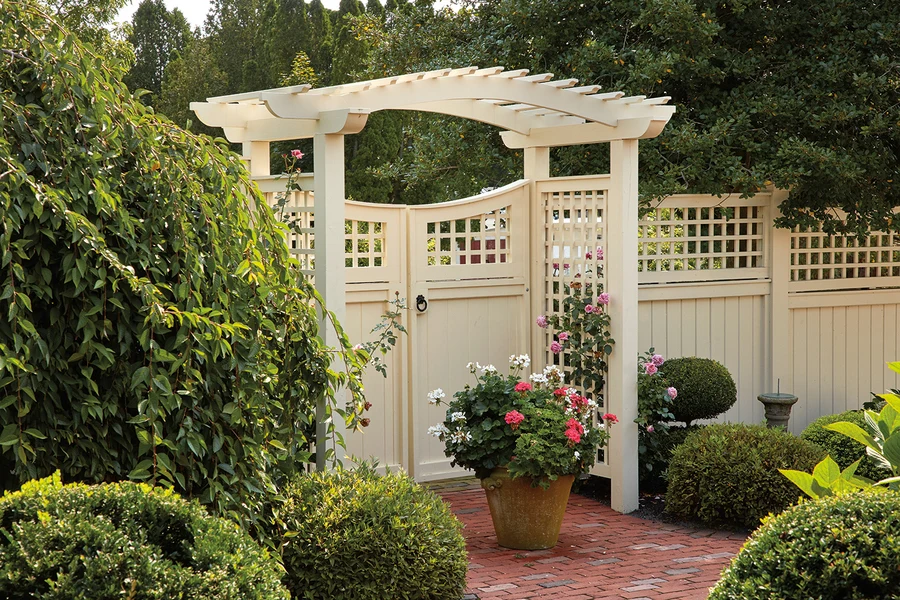
Most people picture a garden arbor and feel something before they can name it. An arch draped with climbing roses. A shaded entrance to a vegetable garden. A white, architectural structure that makes the whole yard feel intentional. That feeling is worth building around.
A garden arbor is a vertical garden structure with posts supporting a slatted or arched roof, sides open or covered with lattice, designed to frame an entrance, define a pathway, or support climbing plants. It sits between a trellis and a pergola in scale and purpose: smaller than a pergola, more architectural than a trellis, and purpose-built for the places in your garden where you want structure to do real work.
This guide focuses on solid cellular vinyl, the best material for long-term durability and classic architectural look your property deserves. We break down the design styles worth considering, how an arbor with a gate changes the feel of a garden, and why choosing a professional-grade structure means you only have to do this project once.
What Is a Garden Arbor?
A garden arbor is an outdoor structure built to be walked through: posts supporting a slatted or arched overhead, sides open or fitted with lattice, positioned where you want a garden to feel like it has a real entrance.
Arbors are transitional structures. They define the boundary between one part of a garden and another: the lawn and the garden room, the path and the gate, the open yard and the shaded retreat. A well-placed garden arbor tells a visitor where to go and makes arriving feel like arriving.
Where arbors sit relative to similar structures: a trellis is a flat, wall-mounted plant support without a walkthrough structure. A pergola is a larger, open-beam structure built to cover a patio or seating area. An arbor is narrower, often arched, and built for entrances and short garden pathways. Walpole Outdoors’ guide on arbors vs. pergolas covers these distinctions in detail if you're still deciding between the two.
The arbor trellis combination is common: lattice panels incorporated into an arbor's sides serve dual purposes, giving the structure visual weight while giving climbing plants a framework to grow against. This is not the same as a standalone trellis, which is flat and wall-dependent. An arbor with integrated lattice is a freestanding architectural element that happens to support plants well.
Garden Arbor Ideas: Five Ways to Use One Well
The best garden arbor ideas are not about aesthetics first. They start with function: what do you want the arbor to do in the space? The design follows from there.
Mark a Garden Entrance
The most common use is the one that delivers the highest return on visual investment. A garden entrance arbor transforms an ordinary opening into a destination. The moment a path leads beneath an arch, the garden on the other side feels deliberate. It does not need to be elaborate. A clean white structure with lattice sides and an arched top reads as a proper entrance even at the simplest scale.
For maximum impact, pair the arbor with fencing that carries through on either side. An arbor floating in an open lawn feels incomplete; an arbor integrated into a fence or hedge line feels like it belongs.
Define an Arbor Walkway
An arbor walkway uses a series of arbors spaced along a path to create a tunnel effect as plants grow over and between them. This is a longer-term garden idea: the structure is planted first, and the canopy arrives over seasons. Wisteria, climbing roses, and honeysuckle are the classic choices for this effect because their density creates overhead cover, and their fragrance makes the passage worth making slowly.
A single arbor over a path still reads as a walkway marker even without the tunnel effect. It intentionally breaks the path, creating a pause rather than an uninterrupted run from one end of the garden to the other.
Create a Seating Retreat
An arbor with a built-in bench turns a structural element into a destination. The Picket Back Bench and Chippendale Back Bench are designed specifically for integration with Walpole Outdoors arbors, creating a covered seating area within the garden's footprint. The overhead structure provides partial shade; the lattice sides create an enclosure without walls. For gardens that lack a dedicated outdoor room, an arbor seating area is the simplest way to create one.
Support Heavy Climbing Plants
An arbor for wisteria or other vigorous climbers is not an afterthought. Wisteria is one of the heaviest and most aggressive vines used in garden design. A mature wisteria in full leaf, loaded with flowers, puts significant structural demand on whatever supports it. A lightweight or poorly constructed arbor will fail under that load, typically through sagging posts or a collapsing overhead structure.
The right arbor for wisteria or climbing hydrangea is built with substantial posts (4" square minimum), a strong overhead framework, and materials that do not degrade under the combination of plant weight and seasonal moisture.
Our solid cellular vinyl is engineered specifically for these heavy loads. We do not use thin metal arches or hollow plastic alternatives because they simply cannot support the weight of a mature plant over time.
Act as a Garden Focal Point
Not every arbor needs to span a path or a gate. A well-placed garden arbor at the end of a sightline, framing a bench or a sculpture, or at the corner of a garden bed works as a vertical architectural statement. It introduces height into a planting scheme that might otherwise be low and horizontal, drawing the eye upward and providing structure even in winter when plants have died back.
Start the conversation about your garden arbor
Garden Arbor Designs: Matching Style to Your Landscape
Walpole Outdoors’ standard range covers eleven distinct arbor designs, each suited to specific architectural contexts and garden styles. The right design is the one whose visual language matches what already exists on your property.
Arched Arbor
The arched arbor is the most traditional form. Expansive arches under decorative carrying beams, with 5" opening horizontal/vertical lattice panels and 4" square posts. Available in 4.5 ft or 6 ft widths, 34" depth, prefinished white. The arch shape reads as classic and welcoming across virtually all residential architectural styles, from colonial to New England traditional. It is the design that requires the least context to work.
Spindle Top Arbor
The Spindle Top is Walpole Outdoors’ most versatile standard arbor. Crafted in solid cellular vinyl with 4" square posts, 3.5" square arch, and 5 ft horizontal/vertical lattice side panels. Available in 3.5 ft, 4 ft, 4.5 ft, and 6 ft widths at 38" depth. The spindle arch detail suits traditional and New England architectural styles; the clean post-and-lattice construction suits more restrained modern interpretations, depending on color. It is available in over 100 vinyl-safe colors with a 25-year warranty, including striking options like iron ore and verde green that move it well away from the standard white.
Sheffield Arbor
The Sheffield features a cathedral spindle arch and 6 ft-wide lattice side panels, crafted from low-maintenance solid cellular vinyl. The cathedral proportion gives it more visual presence than the standard Spindle Top. It is the right choice when the entrance needs to hold its own against an existing architectural scale rather than simply marking a path.
Pergola Style Garden Arbor
The pergola style garden arbor takes a contemporary approach: 4" square posts with 4.5" square decorative carrying beams, 1.5" x 5.5" cross members, and pergola lathing. At 3.5 ft wide and 34.5" deep, it is the narrowest option in the range and suits modern or minimal architectural contexts where a traditional arch would look out of place. Clean horizontal lines, no spindles, no ornamental arch.
Classic Gateway Arbor and Secret Garden Arbor
The Classic Gateway is designed specifically for gardens and walkways where a formal entrance framing is the goal. The Secret Garden Arbor is a more intimate design, suited for garden rooms and side yard entrances where scale is limited. Both are available as standard designs, with custom sizing and material configurations available through Walpole Outdoors’ design process.
The full range of standard designs is available at Walpole Outdoors’ standard arbor collection. For properties that require custom dimensions or architectural details not covered in the standard range, the custom arbor process starts from scratch.
Why Solid Cellular Vinyl Is the Standard for Garden Arbors
Material determines how an arbor looks a decade from now. We focus exclusively on solid cellular vinyl because it is the best material for a low-maintance solution. Unlike a hollow shell or other structures that eventually rot, this material has a consistent density throughout its entire cross-section.
It won’t fade, peel, or split, and withstands constant moisture and UV exposure, keeping upkeep minimal. This makes it the only practical choice for an arbor that will be covered with climbing plants year-round, where access for maintenance is nearly impossible.
Our vinyl accepts vinyl-safe paint in over 100 colors, all backed by a 25-year warranty. This allows you to move beyond standard white and choose options like iron ore black, verde green, or terracotta to match your home's existing palette. Because we use traditional joinery methods, your arbor looks substantial and architectural from the day it’s installed.
For heavy-climbing plants specifically, this material does not degrade under the moisture and weight loads that wisteria or climbing hydrangea imposes over the years. We do not use thin metal arches or hollow plastic alternatives because they simply cannot support the weight of a mature plant over time.
Arbor with Gate: Building a Garden Entrance That Actually Reads as One
An arbor creates a natural garden entrance. By adding a gate, you bring added definition, it controls access, creates anticipation, and turns a threshold into an experience.
The arbor with gate combination works best when the gate is designed as part of the arbor rather than installed as an afterthought. Gate height should align with the arbor's side panel height. Gate styles like spindle, picket, board, or Chippendale should match or complement the arbor's design vocabulary. A Spindle Top arbor paired with a Chestnut Hill concave walk gate is a specific design decision, not a mix-and-match. The two structures speak the same language.
Our arbors are designed with gate integration in mind. Walk gates are sold separately and can be specified alongside the arbor to ensure proportional and stylistic alignment. For an arbor integrated into fencing, the gate choice also needs to relate to the fence panels on either side.
See Walpole Outdoors’ guide to creating a garden enclosure to learn how arbors, gates, and fencing work together as a system rather than individual elements.
Practical note on width: an arbor with a gate needs to be wide enough for the gate panel to swing freely and for two people to pass through without turning sideways. A 4 ft arbor width is the practical minimum for a garden walk gate. 4.5 to 6 ft is more comfortable for a principal garden entrance where you want the passage to feel welcoming rather than functional.
Working With Walpole Outdoors on a Garden Arbor
We have been building arbors and outdoor structures since 1933. Every structure is American-made and designed to look like an intentional extension of your home’s architecture.
The process starts with a design consultation where a Walpole Outdoors designer reviews the site, takes measurements, discusses style preferences and plant intentions, and develops a proposal that treats the arbor as part of the garden's larger design rather than a standalone purchase.
Signature designs are a practical entry point for everyone. Working through Walpole Outdoors’ eleven signature arbor designs helps you develop a clear vocabulary for what you want before the custom conversation starts. The standard range also covers the most common residential applications and ships as a kit, which reduces lead time compared to fully custom work.
For those still early in the process, Walpole Outdoors’ essential arbor guide covers the benefits and placement considerations in detail.