
Choosing between real wood fencing and solid cellular vinyl (CPVC) shapes how your property looks, functions, and holds up over time. A good fence does its job quietly. It defines your space, provides privacy or protection, and helps a property feel complete.
For almost a century, Walpole Outdoors has approached fencing as a long-term design decision rather than a short-term product purchase. Homeowners choose Walpole Outdoors when they want materials, proportions, and finishes considered for how a fence will live beside a home for many years. Walpole Outdoors designs and crafts fencing in New England with the same attention given to exterior trim and architectural millwork, ensuring each project feels considered rather than installed.
This guide is designed to help you choose between real wood and solid cellular vinyl (CPVC) based on how the fence will be used, how you want it to look, and how much maintenance fits your lifestyle.
Why Fencing Matters and What It Should Do for You
At Walpole Outdoors, fencing is first considered by application rather than material. The four categories, Perimeter, Garden, Pool, and Court, define how the fence will be used, its required height, and its relationship to the home. Once the purpose is clear, the choice between real wood and solid cellular vinyl (CPVC) becomes a question of maintenance, appearance, and budget rather than style alone.
A well-chosen fence supports home value in the same way as exterior trim or a thoughtfully placed entry. Walpole Outdoors projects are planned with this outcome in mind so the finished result reads as part of the property rather than an accessory added later. At Walpole Outdoors, fencing is treated as part of the home’s exterior architecture. Proportions, sightlines, and materials are considered together so the result enhances curb appeal while remaining practical for everyday life.
Walpole Outdoors begins with how a family actually uses the property, approach to the front door, movement between house and yard, and seasonal living, so the fence supports daily life rather than simply marking a line. A fence influences more than privacy. It shapes how guests arrive, how children move between spaces, and how a home meets the street each evening. When those moments are considered early, fencing becomes a quiet piece of architecture rather than an element added at the end. This is the difference between a fence that divides land and a fence that completes a home.
The Core Types of Residential Fencing
Walpole Fencing is organized into four categories: Perimeter, Pool, Garden, and Court – each designed to solve a specific need. Privacy or perimeter fencing creates separation and containment, often along property lines or around backyards. More open fencing defines space without blocking views or light, making it well suited for front yards and shared boundaries. Lower fencing helps organize gardens, walkways, and landscape edges without interrupting sightlines.
Walpole Outdoors fencing elements can be tailored in height, spacing, and material, allowing the fence to respond to the home instead of fitting the home to a standard panel. Each type can be adjusted in subtle ways, post dimension, cap profile, picket spacing, and finish, so the final result relates to the home the way built-in architecture would, not the way outdoor furniture might. Rather than beginning with a catalog panel, Walpole Outdoors begins with intention: What does this edge need to do? Who will use it most? How should it feel in winter, in summer, and years from now? Those answers shape the form.
Privacy Fencing: Creating Separation Without Feeling Closed In
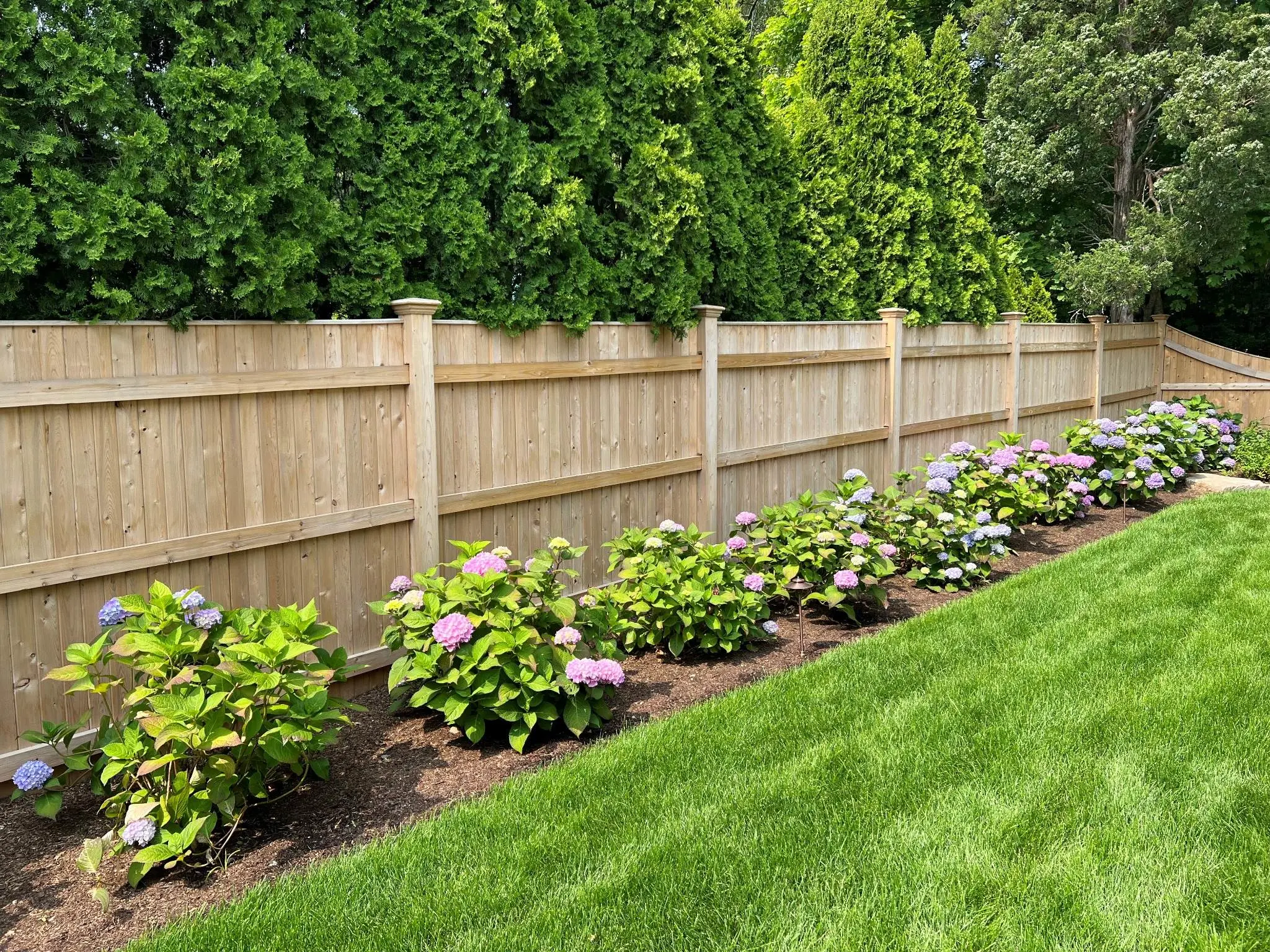
Privacy fencing is most effective when it feels proportionate to the space it encloses. Height, spacing, and material all influence whether a fence feels calm or overwhelming. Clear lines, long-term durability, and thoughtful material choice matter more than aesthetic detail when selecting a privacy fence. Whether using real wood or solid cellular vinyl (CPVC), fences that are too tall or visually heavy may perform well but can dominate a space.
Walpole Outdoors homeowners often compare the warmth and refinishing potential of real wood with the consistency of solid cellular vinyl (CPVC), choosing the material that best matches their expectations for maintenance and appearance over time. Details such as post scale, cap profiles, and panel spacing are adjusted to the home so privacy feels intentional rather than defensive. Gates, hardware, and transitions are treated as focal points rather than accessories, so the most used parts of the fence carry the same quality as the longest runs.
Explore privacy fencing options
Fencing for Front Yards and Visible Boundaries
Front-yard facing fencing often plays a role at the front of the home, where visibility and curb appeal matter most. Proportion and placement are key. Front-yard facing fencing should align with the home's scale, the height of nearby landscaping, and the rhythm of surrounding architecture.
In Walpole Outdoors projects, front-yard fencing is planned much like a porch railing or entry door, an architectural moment that frames the approach and sets the tone for the property. Because this edge is seen every day, Walpole Outdoors considers how the fence meets the driveway, how light passes through pickets, and how the design reads from the street at a distance as well as up close.
Garden and Landscape Fencing That Adds Structure
Garden fencing works best when it’s understated. Its role is to guide movement, protect plantings, and define garden areas without dominating the landscape. Walpole Outdoors details these pieces like exterior millwork, allowing fences, arbors, and pergolas tread as one coherent language rather than separate accessories.
In layered landscapes, this subtle structure becomes the element that holds everything together, allowing seasonal planting to change while the underlying design remains composed. Fence heights are often set to deter deer, with wire underneath to deter bunnies and other pests. Posts, lattice scale, and cap profiles are chosen to complement nearby structures, helping even utilitarian garden enclosures carry the same level of finish as the home itself.
Fencing Ideas for Front Yards, Backyards, and Property Lines
Planning fencing with visibility and use in mind helps create a layout that feels cohesive rather than pieced together. Many Walpole Outdoors clients design their fencing as a complete perimeter from the start, using more decorative styles in highly visible front-yard areas and simpler options in less visible sections while maintaining consistent proportions and material quality throughout.
This phased approach allows the property to evolve while maintaining the same design language and material integrity across decades. Because Walpole Outdoors works across gates, pergolas, and outdoor structures, later additions can speak the same design language, avoiding the patchwork effect common with unrelated systems.
Choosing Fencing That Fits Your Home’s Architecture
Choosing fencing that fits your home’s architecture is less about material alone and more about proportion, profile, and detail. Because Walpole Outdoors works across wood and cellular vinyl, fencing can be designed to match the character of both historic and contemporary homes, including replicating traditional wood fences when needed. The goal is continuity: a fence that feels as natural to the home as a window casing, porch column, or piece of built-in millwork.
Placement Tips for Function and Curb Appeal
Fencing placement has as much impact as fence style. Consistent alignment, thoughtful gate placement, and respect for sightlines all contribute to better results. Small placement decisions can significantly affect how open or closed a space feels.
Fencing should support how people move through the property, defining edges and transitions without interrupting flow. Planning placement early, rather than adjusting after installation begins, often makes the difference between fencing that feels intentional and fencing that feels improvised. Walpole Outdoors evaluates alignment with walkways, driveways, and entries so gates and runs feel intentional rather than convenient.
This evaluation considers how the fence will be used ten years from now, not only where a panel fits today, so placement supports both daily routines and the long view of the property. Even subtle choices, where a gate meets a path, how a fence turns a corner, how height steps with the land, shape whether the finished project feels architectural or merely installed.
Materials, Finishes, and Durability to Consider
Fencing is one of the few parts of a home that faces weather every hour of every season. Because of this exposure, material decisions matter as much as design. Walpole Outdoors guides homeowners through how wood and solid cellular vinyl (CPVC) respond to sun, moisture, and seasonal movement, helping them choose based on how the fence should look five, ten, and twenty years from now.
This guidance reflects conditions common across the Northeast, coastal salt air, freeze-thaw cycles, and summer humidity that affect wood and solid cellular vinyl (CPVC) differently. Drawing on decades of installations, Walpole Outdoors sets expectations, not only for installation day, but for how the fence will live beside the home over time.
Shop fencing materials and styles
Installation and Ongoing Care
Before installation, consider access, terrain, and long-term maintenance. Fencing projects involving slopes, long runs, or structural requirements will especially benefit from professional installation. Routine maintenance plays an important role in long-term performance. Periodic inspections, cleaning, and small adjustments help fencing remain secure and visually consistent. Thoughtful installation paired with basic upkeep allows fencing to perform well and look good for years.
At Walpole Outdoors, installation is treated as part of craftsmanship rather than logistics. Post depth, gate hardware, and joinery details are selected for how they will perform through seasons, not only on installation day. This planning protects the qualities that distinguish a Walpole Outdoors installation: straight sightlines, stable gates, and finishes that continue to look composed as the landscape matures. When maintenance is needed, materials are chosen so care remains straightforward rather than disruptive, allowing the fence to age with the home instead of working against it.
Where to Begin
Start with the end goal for your fencing project. Then, Walpole Outdoors design consultants can translate photographs, sketches, or simple ideas into a coherent plan that reflects how the property is truly used. For many homeowners, the first conversation is about what they want their fence to do – privacy from neighbors, keep kids and dogs away from the street, etc. Then we align on the style, materials, and price that’s right for them.